


From the organization Excelencia in Education at www.EdExcelencia.org:
This terrific organization featured recently highlighted on Hispanic American Village (see previous Navigating Higher Ed for Latinos post) is about to conclude its call for nominations for its 2007 Examples of Excelencia initiative, whose goal is to "identify, celebrate, and promote models, programs, and institutional departments that significantly contribute to improving educational achievement for Latino students in higher education."
The short version is: They are looking for recommendations of educational models and programs THAT WORK. They annually collect, spotlight, recognize, and support with awards examples of "programs and departments that are at the forefront in increasing academic opportunities and improving achievement for Latino students."
The longer version and a nomination form is here at the Call for Examples of Excelencia. If you know about a great teaching model or program, share it with them by April 30!
Wednesday, April 25, 2007
Monday, April 23, 2007
Navigating Higher Ed for Latinos: Part I
Navigating Higher Ed for Latinos: Part I
Added: Part 1 of a series focusing on Hispanic Serving Institutions (HSIs) -- their history, issues and what role they play in the education options available to Hispanic students today
Added: Part 1 of a series focusing on Hispanic Serving Institutions (HSIs) -- their history, issues and what role they play in the education options available to Hispanic students today


Sunday, April 08, 2007
Ken Burns still can't get with the program
After nearly ignoring Latinos in his 14-hour PBS documentary on jazz--Machito, Tito Puente, and Eddie Palmieri were mere dust in the wind--and, in his baseball epic, spending 6 minutes on Roberto Clemente with but a nod to other Hispanic players who have, Hellooo, gained hegemony over the sport, Ken Burns, in his latest attempt to tell it like it is to the US public, completely blows off the 500,000 Latinos who served, and gave their lives, during World War II.
But this time, not so fast. PBS's golden boy is being beleaguered by an organized opposition that is threatening to boycott the Public Broadcasting system if edits aren't made to include the stories of soldiers who received more Congressional Medals of Honor, in proportion to their population, than any other ethnic group. Historian Maggie Rivas-Rodriguez, who's been on the case of Latinos in W.W. II, has formed
Defend the Honor, a coalition attempting to exact apologies and change. The group is being supported by the Hispanic Caucus, and the National Association of Hispanic Journalists has weighed heavily in. So far, PBS and Burns are standing firm on: Sorry Charley, but Burns is a good guy whose artistic integrity shouldn't be messed with. The series is to be aired in November. Let's see if it's still status quo by then.
Meanwhile here's a brief survey of the righteous indignance of the media:
National Public Radio's LatinoUSA--great show. Podcast it.
Alternet
The Albuquerque Journal via HispanicBusiness.com
Maggie Rivas-Rodriguez on Democracy Now
But this time, not so fast. PBS's golden boy is being beleaguered by an organized opposition that is threatening to boycott the Public Broadcasting system if edits aren't made to include the stories of soldiers who received more Congressional Medals of Honor, in proportion to their population, than any other ethnic group. Historian Maggie Rivas-Rodriguez, who's been on the case of Latinos in W.W. II, has formed
Defend the Honor, a coalition attempting to exact apologies and change. The group is being supported by the Hispanic Caucus, and the National Association of Hispanic Journalists has weighed heavily in. So far, PBS and Burns are standing firm on: Sorry Charley, but Burns is a good guy whose artistic integrity shouldn't be messed with. The series is to be aired in November. Let's see if it's still status quo by then.
Meanwhile here's a brief survey of the righteous indignance of the media:
National Public Radio's LatinoUSA--great show. Podcast it.
Alternet
The Albuquerque Journal via HispanicBusiness.com
Maggie Rivas-Rodriguez on Democracy Now
Thursday, April 05, 2007
ASNE Report Finds Percentage of Minorities in Newsrooms Declining
ASNE Report Finds Percentage of Minorities in Newsrooms Declining
According to the American Newspaper Editors Association 2007 survey on the representation of minorities in U.S. news media, the percentages of minority and women journalists working in America’s newsrooms both declined in the past year. According to ASNE, it is only the second time since the survey started in 1978 that the percentage of minorities has declined.
In a year marked by news organization layoffs that were headlines in themselves, ASNE’s annual “census” found that the percentage of minorities fell to 13.62 percent, down from 13.87 last year. The percentage of women also dropped from 37.70 to 37.56 percent.
The percentage of minorities in supervisory roles at daily newspapers dropped to 10.9 percent, equal to the percentage from two years ago. The downward trend holds true for student and entry-level employment as well. According to ASNE’s release, the percentage of minority interns stands at nearly 27 percent, “a number that has continued to fall as newspapers cut back” on internships.
The one silver lining in the report seemed to come from online media. ASNE’s census of daily newspapers for the first time counted full-time staffers who work entirely at online publishing activities by their companies. Among online media staffs, the percentage of minorities on staff was an estimated 16 percent, which helped make the drop in overall employment numbers seem less severe than they might have been.
See a fuller report at IMDiversity, ASNE Report Finds Percentage of Minorities in Newsrooms Declining, or view detailed data tables from the census at the ASNE website.
According to the American Newspaper Editors Association 2007 survey on the representation of minorities in U.S. news media, the percentages of minority and women journalists working in America’s newsrooms both declined in the past year. According to ASNE, it is only the second time since the survey started in 1978 that the percentage of minorities has declined.
In a year marked by news organization layoffs that were headlines in themselves, ASNE’s annual “census” found that the percentage of minorities fell to 13.62 percent, down from 13.87 last year. The percentage of women also dropped from 37.70 to 37.56 percent.
The percentage of minorities in supervisory roles at daily newspapers dropped to 10.9 percent, equal to the percentage from two years ago. The downward trend holds true for student and entry-level employment as well. According to ASNE’s release, the percentage of minority interns stands at nearly 27 percent, “a number that has continued to fall as newspapers cut back” on internships.
The one silver lining in the report seemed to come from online media. ASNE’s census of daily newspapers for the first time counted full-time staffers who work entirely at online publishing activities by their companies. Among online media staffs, the percentage of minorities on staff was an estimated 16 percent, which helped make the drop in overall employment numbers seem less severe than they might have been.
See a fuller report at IMDiversity, ASNE Report Finds Percentage of Minorities in Newsrooms Declining, or view detailed data tables from the census at the ASNE website.
Saturday, March 31, 2007
"Weekend Maintenance on IMDiversity
http://asianamericanvillage.blogspot.com/2007/03/weekend-maintenance-on-imdiversity.html: "Weekend Maintenance on IMDiversity
Our site servers will be undergoing maintenance this weekend, starting midnight Friday. During this period there may brief outages on our sites at IMDiversity.com and the Multicultural Villages, the IMDiversity Career Center and Job Bank, and THE BLACK COLLEGIAN Online Job Bank. We apologize for any inconvenience to our visitors and thank you for your patience."
Our site servers will be undergoing maintenance this weekend, starting midnight Friday. During this period there may brief outages on our sites at IMDiversity.com and the Multicultural Villages, the IMDiversity Career Center and Job Bank, and THE BLACK COLLEGIAN Online Job Bank. We apologize for any inconvenience to our visitors and thank you for your patience."
Weekend Maintenance on IMDiversity
Weekend Maintenance on IMDiversity
Our site servers will be undergoing maintenance this weekend, starting midnight Friday. During this period there may brief outages on our sites at IMDiversity.com and the Multicultural Villages, the IMDiversity Career Center and Job Bank, and THE BLACK COLLEGIAN Online Job Bank. We apologize for any inconvenience to our visitors and thank you for your patience.
Our site servers will be undergoing maintenance this weekend, starting midnight Friday. During this period there may brief outages on our sites at IMDiversity.com and the Multicultural Villages, the IMDiversity Career Center and Job Bank, and THE BLACK COLLEGIAN Online Job Bank. We apologize for any inconvenience to our visitors and thank you for your patience.
Tuesday, March 20, 2007
A.G., the AG is Behind "The Eight" Ball Again
U.S. Attorney General Alberto Gonzales is in hot water again for his ethics (or lack of same). Now, his office has summarily dismissed 8 of their own-appointed US attorneys for not toeing the Administration’s sine qua non on loyalty above juris-prudence, and calls for his head are intensifying.
I’ve got a bit of a nit to pick with yesterday’s otherwise on-target L.A. Times editorial that points out, yet again, that the president’s Latino lawn jockey hasn’t understood that his job as Attorney General is to serve the justice system, and thus the American people, and not the every law-trashing whim of a president who at this point may have fallen into the abyss of Nixionian paranoia. My beefette: The Times blames Bush’s ego--so often the tail side of the paranoia coin--for elevating his own Pancho Gonzales (Cisco was so much more benign, and handsome, than G.W.: my apologies to the memory of Duncan Renaldo) to an august mount grander than the height and breadth of Gonzales’ capabilities, but I think we need to hold Gonzales, and not the president, accountable for his continuing history of spinelessness, human rights abuses (remember his blueprint for torture and calling the Geneva Conventions “quaint?”), and unethical politics.
The clamor for Gonzales’ resignation follows two recent disclosures of impropriety. First, the firings, which, while licit, were carried out as retribution for the prosecutors’ going too soft on the Democrats and too hard on fellow Republicans—many of them had led investigations into cases of political corruption and all had positive job reviews--and were part of an even more insidious 2-year plot hatched right under Gonzales’ nose to “push out,” as the administration put it, many, many more. And, breaking earlier this week, were still further charges of the misuse by the FBI, under Gonzales’ watch, of Patriot Act powers to secretly obtain private information about U.S. citizens.
Even Republicans are expressing outrage at the runaround Gonzales initially gave Congress over the circumstances of the firings, with a number of representatives either signing off on a call for Gonzales’ ouster or stating privately that he should be shown the door. (Gonzales petulantly and patently refused to step down: his only master is the president, he says. For sure.) Republican Senator John Sununu was the first in the upper house to break party ranks, to be followed by Senator Gordon H. Smith, but more are promised to follow.
I’ve been on an intensified Gonzales watch since he was being considered for a Supreme Court seat. I’ve been on the moral high road looking down on Latino organizations like La Raza, Lulac, and the National Association of Latino Journalists whose position was, “He’s not that bad, he’s Hispanic.” See All the President's Hombres here and read fast. By the time you’re done, Al may be finished too.
And, here's the latest from AP on the AG, 94 - 2 agin.
I’ve got a bit of a nit to pick with yesterday’s otherwise on-target L.A. Times editorial that points out, yet again, that the president’s Latino lawn jockey hasn’t understood that his job as Attorney General is to serve the justice system, and thus the American people, and not the every law-trashing whim of a president who at this point may have fallen into the abyss of Nixionian paranoia. My beefette: The Times blames Bush’s ego--so often the tail side of the paranoia coin--for elevating his own Pancho Gonzales (Cisco was so much more benign, and handsome, than G.W.: my apologies to the memory of Duncan Renaldo) to an august mount grander than the height and breadth of Gonzales’ capabilities, but I think we need to hold Gonzales, and not the president, accountable for his continuing history of spinelessness, human rights abuses (remember his blueprint for torture and calling the Geneva Conventions “quaint?”), and unethical politics.
The clamor for Gonzales’ resignation follows two recent disclosures of impropriety. First, the firings, which, while licit, were carried out as retribution for the prosecutors’ going too soft on the Democrats and too hard on fellow Republicans—many of them had led investigations into cases of political corruption and all had positive job reviews--and were part of an even more insidious 2-year plot hatched right under Gonzales’ nose to “push out,” as the administration put it, many, many more. And, breaking earlier this week, were still further charges of the misuse by the FBI, under Gonzales’ watch, of Patriot Act powers to secretly obtain private information about U.S. citizens.
Even Republicans are expressing outrage at the runaround Gonzales initially gave Congress over the circumstances of the firings, with a number of representatives either signing off on a call for Gonzales’ ouster or stating privately that he should be shown the door. (Gonzales petulantly and patently refused to step down: his only master is the president, he says. For sure.) Republican Senator John Sununu was the first in the upper house to break party ranks, to be followed by Senator Gordon H. Smith, but more are promised to follow.
I’ve been on an intensified Gonzales watch since he was being considered for a Supreme Court seat. I’ve been on the moral high road looking down on Latino organizations like La Raza, Lulac, and the National Association of Latino Journalists whose position was, “He’s not that bad, he’s Hispanic.” See All the President's Hombres here and read fast. By the time you’re done, Al may be finished too.
And, here's the latest from AP on the AG, 94 - 2 agin.
Saturday, March 17, 2007
Change provokes anxiety, especially when race is involved
I found this recent feature in the LA Times honest and provocative and a fitting companion to the explorations we at the HAV have been doing on the thorny, at times lamentable, relations between our black and Hispanic communities. And so I pass along to you Erin Aubry Kaplan's More than just the Latinos next-door.
Your own reflections are more than welcomed.
Some of ours are here:
LA's Black-Brown Divisions Deepen
Explorations in Black and Tan (as we move East to NY)
Your own reflections are more than welcomed.
Some of ours are here:
LA's Black-Brown Divisions Deepen
Explorations in Black and Tan (as we move East to NY)
Thursday, March 15, 2007
Announcement: NEH Humanities Initiatives for Faculty Grants
Humanities Initiatives for Faculty are intended to strengthen and enrich humanities education and scholarship at Institutions with High Hispanic Enrollment. These grants may be used to enhance the humanities content of existing programs, develop new programs, or lay the foundation for more extensive endeavors in the future.
For 2007, NEH is particularly interested in proposals in the following categories: (1) American history; (2) world literatures; (3) languages; (4) humanities connections to science, medicine, and technology; and (5) humanities approaches to business, law, and economics. Applications for projects in all disciplines of the humanities, however, are eligible for funding and encouraged.
Preliminary proposals (optional): The staff recommends that preliminary proposals be sent so as to be received by May 31, 2007.
Applications must be received by Grants.gov by June 15, 2007.
More guidelines info here
For 2007, NEH is particularly interested in proposals in the following categories: (1) American history; (2) world literatures; (3) languages; (4) humanities connections to science, medicine, and technology; and (5) humanities approaches to business, law, and economics. Applications for projects in all disciplines of the humanities, however, are eligible for funding and encouraged.
Preliminary proposals (optional): The staff recommends that preliminary proposals be sent so as to be received by May 31, 2007.
Applications must be received by Grants.gov by June 15, 2007.
More guidelines info here
Thursday, March 01, 2007
Tuesday, February 20, 2007
Bordertown or Boredertown?
It looks like Mexican Amereican filmmakers, Gregory Nava and Lourdes Portillo, are circling each other, with Nava on the inside, more traveled track and Portillo on the outer, less-traveled road. Both dedicated movies to the slain Tejana diva, Selena, an icon amongst Chicanos who was moving to that crossover superstardom shared by Jennifer Lopez, who plays Selena in the film, Lopez' husband, Marc Anthony, and a growing host of other mainstream Latino performers. Nava's Selena takes the typical tear-stained, slick Hollywood freeway--no real ruts, bumps or grit along this road--while Portillo's Corpus: A Home Movie for Selena acts as an antidote to the sugar overload, tackling the more nettlesome issues of Latina femininity and the need for cultural standard bearers.
Nava again shadows Portillo with the release, last Thursday at the Berlin Film Festival, of the feature, Bordertown, the story explored and nearly broken over 5 years ago by Portillo, of the hundreds, yes hundreds, of young Mexican girls come to the sin and maquiladora city of Juarez, Mexico, looking for work and finding fiendish, ritualized murder. Jennifer Lopez returns, this time as an intrepid reporter out to break the story. (Antonio Banderas adds his creds to the movie.) I suspect that the trailers flaunting an infinitely unconvincing Lopez beset by an incessant breeze and icy law enforcement officers, are a portend of even less satisfying fare to come. Senorita Extraviada, on the other hand, is, as a documentary immensely provocative and wide-ranging. It makes us all think deeply, again, about the image of women in Latina society, and of people's motivations for doing all the many noble and nefarious things we all do.
See my review of Senorita Extraviada on the Hispanic American Village
And let me know what you think of Bordertown.
Nava again shadows Portillo with the release, last Thursday at the Berlin Film Festival, of the feature, Bordertown, the story explored and nearly broken over 5 years ago by Portillo, of the hundreds, yes hundreds, of young Mexican girls come to the sin and maquiladora city of Juarez, Mexico, looking for work and finding fiendish, ritualized murder. Jennifer Lopez returns, this time as an intrepid reporter out to break the story. (Antonio Banderas adds his creds to the movie.) I suspect that the trailers flaunting an infinitely unconvincing Lopez beset by an incessant breeze and icy law enforcement officers, are a portend of even less satisfying fare to come. Senorita Extraviada, on the other hand, is, as a documentary immensely provocative and wide-ranging. It makes us all think deeply, again, about the image of women in Latina society, and of people's motivations for doing all the many noble and nefarious things we all do.
See my review of Senorita Extraviada on the Hispanic American Village
And let me know what you think of Bordertown.
Monday, February 05, 2007
Bill Richardson at "Meet the Candidates"
From the weekend's DNC Winter Meeting in Washington, DC, a video of Bill Richardson.
[We were having trouble with the display on the DNC blog tonight, but they also provide a link for direct download of the WMV format file (Right-click and "Save As").]
Other recent readings of interest at HAV: Richardson: Candidate (?) with portfolio
Though overshadowed by Hillary and Barack, Bill Richardson's chances at the Dem nod are not so slim
[We were having trouble with the display on the DNC blog tonight, but they also provide a link for direct download of the WMV format file (Right-click and "Save As").]
Other recent readings of interest at HAV: Richardson: Candidate (?) with portfolio
Though overshadowed by Hillary and Barack, Bill Richardson's chances at the Dem nod are not so slim
Tuesday, January 16, 2007
California Campus: Springboard or dumping ground?
I came across this provocative article this morning in the LA Times on the University of California at Riverside. (Read it here.) The school is part of the state's vast system of higher learning and attracts a majority of minority students, several of whom express gratitude for being there, enjoying both the diversity and ability to advance their education amongst folks from their own identity group. UC Riverside has the highest percentage of African Americans and, except for the new, much smaller Merced campus, largest enrollment of Latinos in the system.
UC Riverside offers success-supporting perks such as financial aid packages, race-based programs, and "bridge [remedial] classes" for incoming students in need of help in Math and English.
UC Riverside's chancellor is a Latina, France A. Cordova, the first in the California system.
Some claim, though, that with the prestigious UCLA and UC Berkeley white and Asian bloated, the system is merely using UC Riverside as a dumping ground.
UC Riverside offers success-supporting perks such as financial aid packages, race-based programs, and "bridge [remedial] classes" for incoming students in need of help in Math and English.
UC Riverside's chancellor is a Latina, France A. Cordova, the first in the California system.
Some claim, though, that with the prestigious UCLA and UC Berkeley white and Asian bloated, the system is merely using UC Riverside as a dumping ground.
Monday, January 08, 2007
Chomsky augurs a bright future for the Americas
MIT professor and the dean of critics of US foreign policy, Noam Chomsky, has apparently forgiven Venezuelan president, Hugo Chavez, for pronouncing him dead. Chavez promoted his book, Hegemony or Survival: America's Quest for Global Dominance, a few months back, saying he regretted not having met the distinguished septuagenarian professor before he died. Not only did sales of the book skyrocket after the plug, but Chomsky has come out with a provocative and cogent op-ed in the International Herald Tribune, using the occasion of the death of US-backed former Chilean dictator, Agusto Pinochet, to grace a new era in Latin American development and integration led by Chavez and Latin America's emerging crop of leaders. Following Chavez and his neo-socialist Bolivarian reforms is the more measured (Luiz Iñacio) Lula (da Silva) in Brazil; Nestor Kirchner in Argentina; Evo Morales, first indigenous head of state in overwhelmingly indigenous Bolivia; Michelle Bachelet, detained under Pinochet and whose father was martyred by the regime; Tabaré Vasquez of Uruguay; Rafael Correa, just inaugurated in Ecuador; and the old thorn in the US's side, Daniel Ortega, recently reinstalled as president of Nicaragua after 16 years on the sidelines. And how can we forget President Fidel Castro and the failing leader's proxies in Havana, not merely a thorn, but the bane of many administrations' existence for over 40 years?
Chomsky writes eloquently and succinctly of his shared vision for an "alternative future [overcoming] a legacy of empire and terror."
Enjoy, reflect, react; let us know what you think:
South America: Toward an alternative future
Chomsky writes eloquently and succinctly of his shared vision for an "alternative future [overcoming] a legacy of empire and terror."
Enjoy, reflect, react; let us know what you think:
South America: Toward an alternative future
Saturday, December 16, 2006
Mel Maligns the Maya in his latest disaster (of a) movie
The article "in the flesh"
See also the Hispanic American Village for more on Apocalypto
Mad Mel and the Maya
by EARL SHORRIS
The Nation
December 18, 2006 issue
On the Yucatán peninsula, where many of the Maya of Mexico live, there is an often-told story about people like Mel Gibson, whose bloody movie in the Yucatecan Maya language, Apocalypto, will be released December 8. I first heard the story from Miguel Angel May May, a tall man among the Maya, handsome, now in his 40s, with a touch of gray in his hair. He speaks Yucatecan Maya so eloquently that when young people who have begun to lose their language and culture first hear him, they shed tears for what has been and what can be in the Yucatán.
May May tells the story with the kind of rage and pride that Gibson tried to portray with his Scottish heroes in Braveheart and postapocalyptic picaros in Mad Max: "A Maya, of the middle class, like me," May May said, "went into a Ford dealership here in Mérida. He intended to buy a new pickup truck. He was well dressed, but clearly Maya. The dealer offered him ten pesos to wash a truck." It is a common experience for people of color in a white world. The Yucatán is not entirely a white world, yet the Maya suffer the most severe prejudice of any large ethnic group in Mexico. In the language of prejudice in Mexico, the Maya are said to be people with big heads and no brains, too short, too dark and with a strange, laughable Spanish accent. Gibson accepted the stereotype and embellished it.
To grasp what a racist act Gibson has committed in the making of his new film, it is necessary to understand the world of the Maya as it exists today. Perhaps realizing what has been done to the Maya in the film, Gibson has been seeking allies among Latinos and American Indians. He even went so far as to tell Time magazine, "The fear mongering we depict in this film reminds me a little of President Bush and his guys."
In fact, Gibson stepped into a delicate cultural situation and may have shattered much of what has been built by indigenous people, historians and linguists in recent years. Ethnic prejudice is as harsh in the Yucatán as anywhere in the Americas. I have seen it played out in the Maya villages as well as in the cities and on the beaches. When the Clemente Course, which educates indigenous people as well as the poor in seven countries, taught its first class in the Maya language and humanities in the small village of San Antonio Sihó, the students told me that when they took the bus to Mérida (a journey of more than fifty miles) they were afraid to speak Maya, because people would think them stupid Indians (Mayeros). After two years of study, José Chim Kú, the student leader of the class, said, "Now, when I ride on the bus, I speak only Maya." It took two years for the faculty, including May May, to effect the change, for the Maya have internalized their recent history. And like all people who live in the violent mirror of racial and ethnic hatred, they suffer for their suffering. It is the bitterest irony of colonialism.
In the film Apocalypto, which Gibson claims will make the Maya language "cool again," there are many major roles. The lead is a lithe, handsome young man, a dancer from Oklahoma named Rudy Youngblood. He has indigenous ancestors, but he is not Maya, and like most of the other featured players he is not a professional actor. None of the four other major parts went to Maya either. According to Gibson, they are played by people from the United States, and the other featured players are either from Mexico City or Oaxaca. Yet every word spoken in the film is in Yucatecan Maya, a difficult language to learn or even to mimic, because it is both tonal and accented.
It is not as if Gibson had few Mayeros to choose from. There are more than a million Maya in Mexico, and more than 100,000 of them are monolingual Yucatecan Maya speakers. Yet Gibson chose not one Maya for a featured role. In so doing, he has made a film that reinforces the prejudice against the Maya, who have defended their cultural autonomy as fiercely as any people on earth. Twice they repulsed the Spaniard Francisco de Montejo, before he occupied part of the peninsula in 1527. They continued to fight pitched battles against European cultural and political dominance until the end of the Caste War in the early twentieth century. And even now militant organizations deep in the jungles of the state of Quintana Roo practice ancient rituals and resist Occidental cultural and political hegemony, including the Gregorian calendar. But the people have never been attacked by Hollywood.
Like the owners of the resort hotels that line the beautiful beaches of Cancún and Cozumel, Mel Gibson cast no Maya to work on his project, except in the most minor roles. Maya nationalists think the hotels and tourist packages that use the word "Maya" or "Mayaland" (a translation of Mayab) should pay for what they appropriate for their own use. The Maya patrimony, they say, is neither gold nor silver nor vast stretches of rich farmland; they have only their history, their culture, themselves. Like the hotel owners who bring strangers to the Yucatán to do everything but labor in the laundries and maintain the grounds, Gibson has brought in strangers to take the good parts from the Maya. He said in an interview that he chose people who "looked like you imagined they should," but I have seen photographs of Rudy Youngblood, and he does not look like any Maya I ever saw. One can only ascribe the choice of Youngblood and the other non-Maya to stereotypes that Gibson has adopted.
In casting and producing the film Gibson reinforced a colonialist concept of indigenous people that has long existed in Mexico. Ancient Maya culture was extraordinary, as the rest of the world now recognizes. The Maya invented one of the few original systems of phonetic writing (we are familiar with the Chinese system and the one that culminated in Latin script). They worked with the concept of zero long before it was known in Europe. They were superb astronomers. Their art and architecture are now known and studied throughout the world. It is also true that they were warriors and that they engaged in human sacrifice, although not on the grand scale of the Mexica. Their ability to manage large-scale military and civic works was impressive. Maya literature has a long and grand history, from the ancient words incised in stone through the Pop Wuj (Popol Vuh) and the postinvasion books of Chilam Balam to the eighteenth-century poems ("Kay Nicte" - Flower Song - and others) to contemporary works, including brilliant poetry by Briceida Cuevas Cob in Yucatecan Maya and Humberto Ak'abal in Ki'che and Miguel Angel May May's delightful fables.
(NOTE: THERE IS NO EVIDENCE THAT THE MEXICA (AZTECS) ACTUALLY PRACTICED HUMAN SACRIFICE ON A GRAND SCALE; THAT STORY COMES FROM SPANIARDS WHO CLAIMED TO SEE SUCH RITES FROM MILES AWAY. THERE IS ABUNDANT EVIDENCE, HOWEVER, THAT THE SPANISH CONQUEST OF MEXICO WAS EXTREMELY BLOODY; PERHAPS THEY WERE TRYING TO JUSTIFY THAT THROUGH EMBELLISHING OR INVENTING AZTEC CRUELTY - AND PERHAPS THAT OF THE MAYA AS WELL.)
Culture doesn't sell tickets. Violence does. Gibson has made what he calls "a chase movie." As we saw his Scot disemboweled and his Jesus battered into bloody meat, we will now see a young Maya running through the jungle to escape having his still beating heart torn from his chest. The social philosophy of Jesus found no place in Gibson's Passion of the Christ, and the glory of Maya culture cannot be featured in a "chase movie." "Blood! More blood!" Gibson shouted during the filming.
According to the Maya calendar, the world will end in 2012, but there have already been four creations in the Maya vision of the cosmos, and there is no reason to think they do not expect another. For the title of his movie Gibson chose a Greek word related to the ideas in the Book of Revelation: apocalypse. Gibson has tried to sell the movie as an allegory, using the fall of Maya civilization to limn the war in Iraq. But it is not about Iraq, and the end of the Maya classic period took place many centuries before the period Gibson chose for his film. The only profound meaning one can take away from the film is that there is an intimate connection between racism and violence. The message of the production is that the Maya are unacceptable people; we do not want to look at them as they are now, and we despise them for what they were then.
See also the Hispanic American Village for more on Apocalypto
Mad Mel and the Maya
by EARL SHORRIS
The Nation
December 18, 2006 issue
On the Yucatán peninsula, where many of the Maya of Mexico live, there is an often-told story about people like Mel Gibson, whose bloody movie in the Yucatecan Maya language, Apocalypto, will be released December 8. I first heard the story from Miguel Angel May May, a tall man among the Maya, handsome, now in his 40s, with a touch of gray in his hair. He speaks Yucatecan Maya so eloquently that when young people who have begun to lose their language and culture first hear him, they shed tears for what has been and what can be in the Yucatán.
May May tells the story with the kind of rage and pride that Gibson tried to portray with his Scottish heroes in Braveheart and postapocalyptic picaros in Mad Max: "A Maya, of the middle class, like me," May May said, "went into a Ford dealership here in Mérida. He intended to buy a new pickup truck. He was well dressed, but clearly Maya. The dealer offered him ten pesos to wash a truck." It is a common experience for people of color in a white world. The Yucatán is not entirely a white world, yet the Maya suffer the most severe prejudice of any large ethnic group in Mexico. In the language of prejudice in Mexico, the Maya are said to be people with big heads and no brains, too short, too dark and with a strange, laughable Spanish accent. Gibson accepted the stereotype and embellished it.
To grasp what a racist act Gibson has committed in the making of his new film, it is necessary to understand the world of the Maya as it exists today. Perhaps realizing what has been done to the Maya in the film, Gibson has been seeking allies among Latinos and American Indians. He even went so far as to tell Time magazine, "The fear mongering we depict in this film reminds me a little of President Bush and his guys."
In fact, Gibson stepped into a delicate cultural situation and may have shattered much of what has been built by indigenous people, historians and linguists in recent years. Ethnic prejudice is as harsh in the Yucatán as anywhere in the Americas. I have seen it played out in the Maya villages as well as in the cities and on the beaches. When the Clemente Course, which educates indigenous people as well as the poor in seven countries, taught its first class in the Maya language and humanities in the small village of San Antonio Sihó, the students told me that when they took the bus to Mérida (a journey of more than fifty miles) they were afraid to speak Maya, because people would think them stupid Indians (Mayeros). After two years of study, José Chim Kú, the student leader of the class, said, "Now, when I ride on the bus, I speak only Maya." It took two years for the faculty, including May May, to effect the change, for the Maya have internalized their recent history. And like all people who live in the violent mirror of racial and ethnic hatred, they suffer for their suffering. It is the bitterest irony of colonialism.
In the film Apocalypto, which Gibson claims will make the Maya language "cool again," there are many major roles. The lead is a lithe, handsome young man, a dancer from Oklahoma named Rudy Youngblood. He has indigenous ancestors, but he is not Maya, and like most of the other featured players he is not a professional actor. None of the four other major parts went to Maya either. According to Gibson, they are played by people from the United States, and the other featured players are either from Mexico City or Oaxaca. Yet every word spoken in the film is in Yucatecan Maya, a difficult language to learn or even to mimic, because it is both tonal and accented.
It is not as if Gibson had few Mayeros to choose from. There are more than a million Maya in Mexico, and more than 100,000 of them are monolingual Yucatecan Maya speakers. Yet Gibson chose not one Maya for a featured role. In so doing, he has made a film that reinforces the prejudice against the Maya, who have defended their cultural autonomy as fiercely as any people on earth. Twice they repulsed the Spaniard Francisco de Montejo, before he occupied part of the peninsula in 1527. They continued to fight pitched battles against European cultural and political dominance until the end of the Caste War in the early twentieth century. And even now militant organizations deep in the jungles of the state of Quintana Roo practice ancient rituals and resist Occidental cultural and political hegemony, including the Gregorian calendar. But the people have never been attacked by Hollywood.
Like the owners of the resort hotels that line the beautiful beaches of Cancún and Cozumel, Mel Gibson cast no Maya to work on his project, except in the most minor roles. Maya nationalists think the hotels and tourist packages that use the word "Maya" or "Mayaland" (a translation of Mayab) should pay for what they appropriate for their own use. The Maya patrimony, they say, is neither gold nor silver nor vast stretches of rich farmland; they have only their history, their culture, themselves. Like the hotel owners who bring strangers to the Yucatán to do everything but labor in the laundries and maintain the grounds, Gibson has brought in strangers to take the good parts from the Maya. He said in an interview that he chose people who "looked like you imagined they should," but I have seen photographs of Rudy Youngblood, and he does not look like any Maya I ever saw. One can only ascribe the choice of Youngblood and the other non-Maya to stereotypes that Gibson has adopted.
In casting and producing the film Gibson reinforced a colonialist concept of indigenous people that has long existed in Mexico. Ancient Maya culture was extraordinary, as the rest of the world now recognizes. The Maya invented one of the few original systems of phonetic writing (we are familiar with the Chinese system and the one that culminated in Latin script). They worked with the concept of zero long before it was known in Europe. They were superb astronomers. Their art and architecture are now known and studied throughout the world. It is also true that they were warriors and that they engaged in human sacrifice, although not on the grand scale of the Mexica. Their ability to manage large-scale military and civic works was impressive. Maya literature has a long and grand history, from the ancient words incised in stone through the Pop Wuj (Popol Vuh) and the postinvasion books of Chilam Balam to the eighteenth-century poems ("Kay Nicte" - Flower Song - and others) to contemporary works, including brilliant poetry by Briceida Cuevas Cob in Yucatecan Maya and Humberto Ak'abal in Ki'che and Miguel Angel May May's delightful fables.
(NOTE: THERE IS NO EVIDENCE THAT THE MEXICA (AZTECS) ACTUALLY PRACTICED HUMAN SACRIFICE ON A GRAND SCALE; THAT STORY COMES FROM SPANIARDS WHO CLAIMED TO SEE SUCH RITES FROM MILES AWAY. THERE IS ABUNDANT EVIDENCE, HOWEVER, THAT THE SPANISH CONQUEST OF MEXICO WAS EXTREMELY BLOODY; PERHAPS THEY WERE TRYING TO JUSTIFY THAT THROUGH EMBELLISHING OR INVENTING AZTEC CRUELTY - AND PERHAPS THAT OF THE MAYA AS WELL.)
Culture doesn't sell tickets. Violence does. Gibson has made what he calls "a chase movie." As we saw his Scot disemboweled and his Jesus battered into bloody meat, we will now see a young Maya running through the jungle to escape having his still beating heart torn from his chest. The social philosophy of Jesus found no place in Gibson's Passion of the Christ, and the glory of Maya culture cannot be featured in a "chase movie." "Blood! More blood!" Gibson shouted during the filming.
According to the Maya calendar, the world will end in 2012, but there have already been four creations in the Maya vision of the cosmos, and there is no reason to think they do not expect another. For the title of his movie Gibson chose a Greek word related to the ideas in the Book of Revelation: apocalypse. Gibson has tried to sell the movie as an allegory, using the fall of Maya civilization to limn the war in Iraq. But it is not about Iraq, and the end of the Maya classic period took place many centuries before the period Gibson chose for his film. The only profound meaning one can take away from the film is that there is an intimate connection between racism and violence. The message of the production is that the Maya are unacceptable people; we do not want to look at them as they are now, and we despise them for what they were then.
Wednesday, December 06, 2006
Find "The Invisible Mexicans"
I've just viewed a documentary everyone should see. "The Invisible Mexicans of Deer Canyon" is an immigration film that brings the viewer into intimate contact with the struggle migrant workers face: their living conditions, the challenges of finding work, of supporting themselves and their families, the forces of intolerance and dismissal they must constantly contend with, and, finally the role of faith in seeing them through.
The film's just out and filmaker John Carlos Frey tells me they're lining up screenings in the West now, with showings in the East to follow.
Check the Hispanic American Village for a full review and check out "The Invisible Mexicans" web site for a trailer, more info and for upcoming screenings.
Monday, December 04, 2006
Afro-Venezuelans Want in in Chavez' Revolution
With a resounding victory in yesterday's election behind him, Cezar Chavez must continue to pursue his commitment to the poor of Venezuela. But there's one group that's questioning the substance behind Chavez' rhetoric: Afro-Venezuelans. Slate Magazine offers a provocative and revealing picture of the marginalization of 30% of the population and how, until now, so few have been able to lift up the rug of race to find what's been swept under it. Read: Is there a "Black Vote" in Venezuela?
Wednesday, November 29, 2006
Reporting from the ground in Oaxaca - v
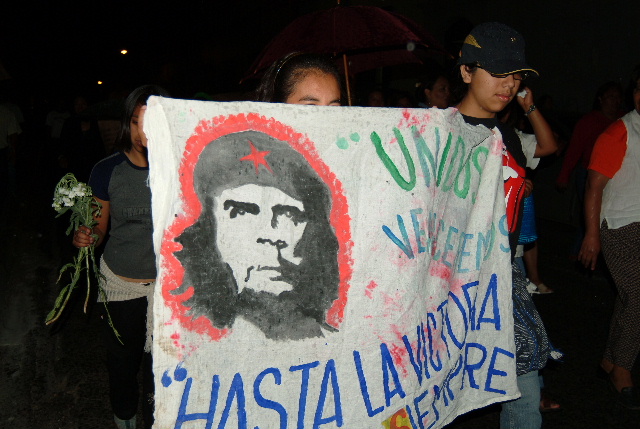
This is the 5th installment of reportage and images, sent by Honduran-US artist and activist, Francisco Alvarado-Juarez, on the 7th, Nov. After an almost 3-week lull, there has been another surge of violence, with bands of youth wielding rocks and rage through the city Saturday night and Sunday, torching government buildings, as demands for presumably corrupt, hard-line governor, Ulises Ruiz, have gone unheard. We're awaiting word from Francisco now on the disturbances, which have sent 10 people to the hospital so far. We've got the story up on our AP feed for the week [see here], but the reporting seems to be heavily slanted towards the Mexican government's official line. See Francisco's earlier posts for a closer look . (And his web site, if not already visited, for more about him and his work: Francisco Alvarado
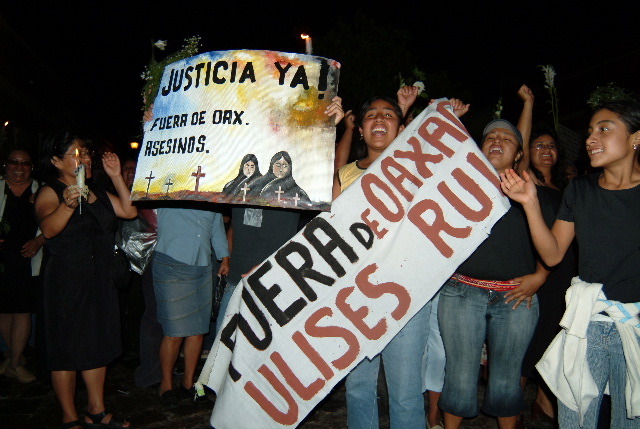
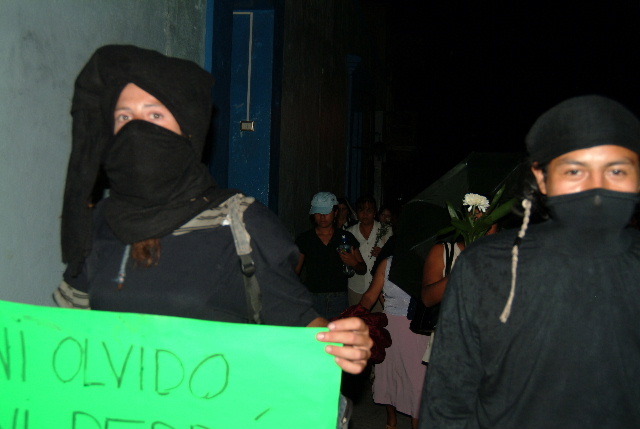
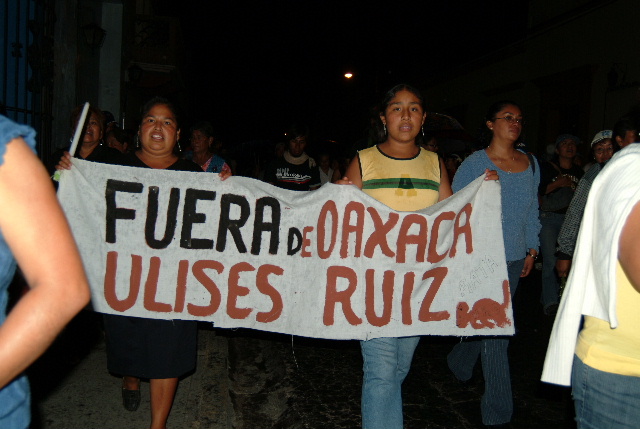
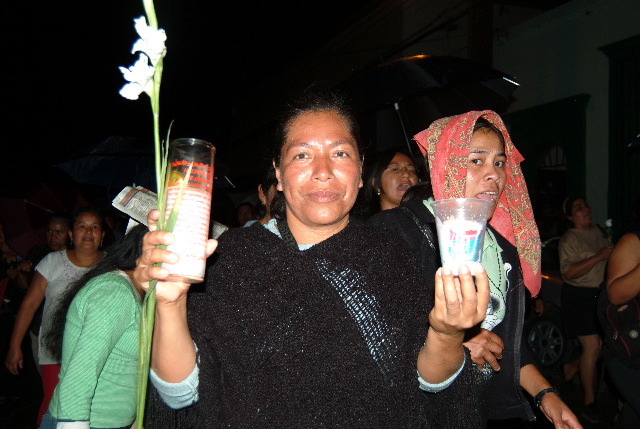
Some Dramatic Relief from the Grief of Oaxaca...



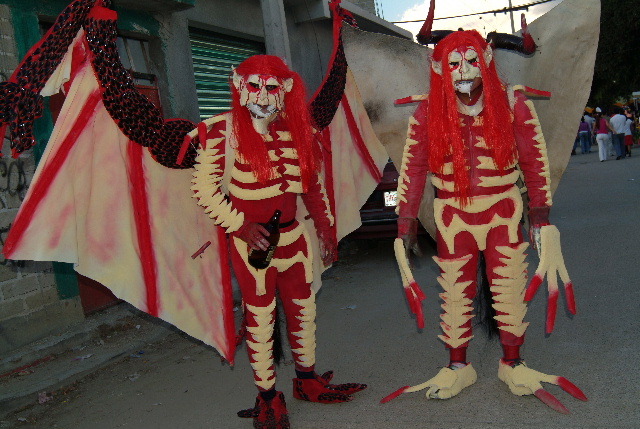 ...Thanks to the penetrating eye of our friend, Francisco, on break from covering the pitched battles between the citizenry and the authorities.
 November 9, 2006
Dear Friends and Colleagues:
I take a brief break from the protest marches of the Battle of Oaxaca to bring you my recent selection of photos from yesterday’s “Octava” or the eighth day of the Day of the Dead Celebrations in Soledad, Etla, Oaxaca.
Francisco
9 de noviembre, 2006
Estimados Amigos y Colegas:
Me tomo un pequeño descanso de las marchas
para enviarles la reciente selección de mis fotos
de la celebración de la Octava de Muertos en
Soledad, Etla, Oaxaca.
Francisco
Tuesday, November 21, 2006
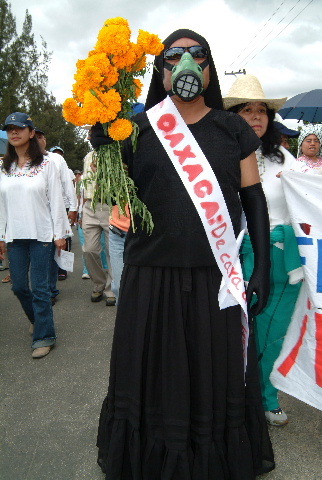
Reporting from the ground in Oaxaca - iv
Commentary and images by Francisco Alvarado-Juarez
Oaxaca, 2:40 PM, Domingo, 5 de noviembre, 2006
Estimados Amigos y Colegas:
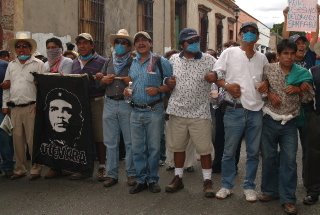
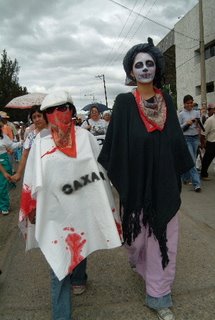
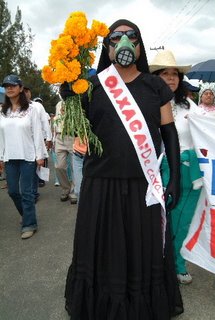
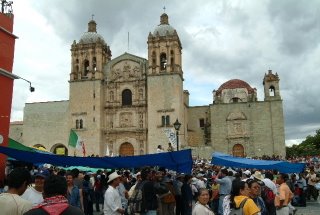
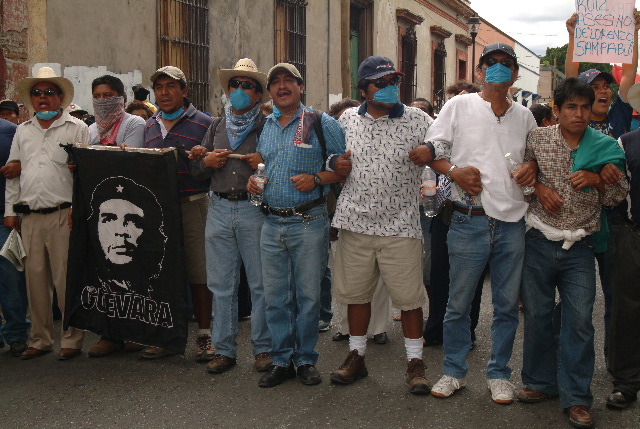
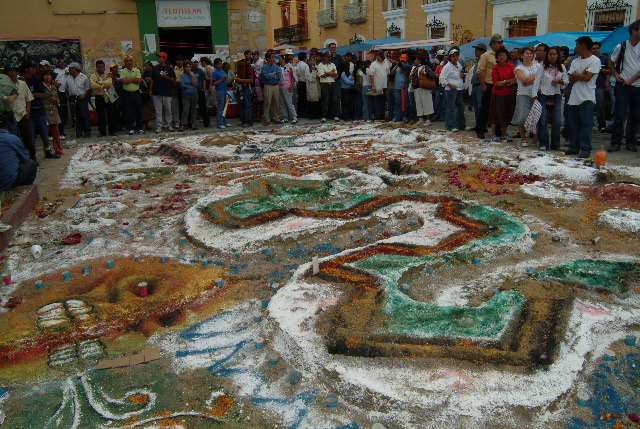
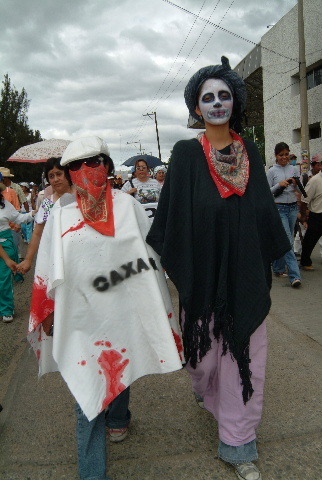
La Mega-Marcha pacífica de hoy un aproximado de cinco kilómetros de personas (500,0000) que inició en las afueras de la ciudad y entró hasta el Centro Histórico congregándose frente a la Iglesia de Santo Domingo a unas cuadras del Zócalo, continua sin ninguna confrontación. Mujeres, niños y hombres forman parte de la protesta contra las fuerzas invasoras de la PFP y el ejército. Adjuntos a la marcha, muchos artistas crean “performance”.
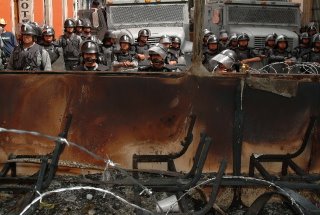
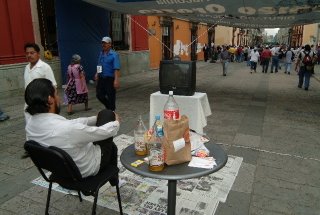
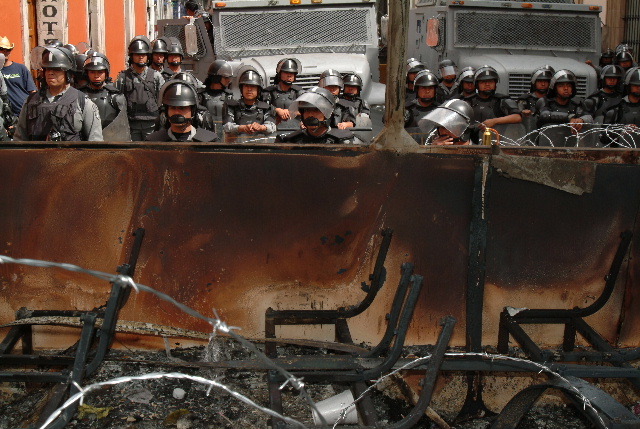
La Policía Federal Preventiva se atrincheró en el Zócalo utilizando las mismas barricadas de los maestros. Les incluyo algunas fotos de hoy.
Saludos,
Francisco
Dear friends and colleagues,
Today's peaceful Mega-March, covering approximately 5 kilometers of about 500,000 people began on the outskirts of the city, entering and moving towards the Historic Center and amassing opposite the Church of Santo Domingo, a few blocks from the Main Square. It has been proceeding without confrontation. Women, children and men are all part of the protest against the invading forces of the PFP (federal anti-riot force) and the army. As part of the march, many artists are creating "performance", or street theatre. The PFP has retrenched in the Main Square, using the same barricades that the teachers did [in the latters' demonstrations of earlier this year]. I'm including for you some of today's photos.

 Way to go!
Oaxaca, 2:40 PM, Domingo, 5 de noviembre, 2006
Estimados Amigos y Colegas:
La Mega-Marcha pacífica de hoy un aproximado de cinco kilómetros de personas (500,0000) que inició en las afueras de la ciudad y entró hasta el Centro Histórico congregándose frente a la Iglesia de Santo Domingo a unas cuadras del Zócalo, continua sin ninguna confrontación. Mujeres, niños y hombres forman parte de la protesta contra las fuerzas invasoras de la PFP y el ejército. Adjuntos a la marcha, muchos artistas crean “performance”.
La Policía Federal Preventiva se atrincheró en el Zócalo utilizando las mismas barricadas de los maestros. Les incluyo algunas fotos de hoy.
Saludos,
Francisco
Dear friends and colleagues,
Today's peaceful Mega-March, covering approximately 5 kilometers of about 500,000 people began on the outskirts of the city, entering and moving towards the Historic Center and amassing opposite the Church of Santo Domingo, a few blocks from the Main Square. It has been proceeding without confrontation. Women, children and men are all part of the protest against the invading forces of the PFP (federal anti-riot force) and the army. As part of the march, many artists are creating "performance", or street theatre. The PFP has retrenched in the Main Square, using the same barricades that the teachers did [in the latters' demonstrations of earlier this year]. I'm including for you some of today's photos.

 Way to go!
Subscribe to:
Posts (Atom)


